Small enough to belong and strong enough to thrive
Texas should pursue a rural resurgence in which data center investment helps strengthen existing towns and supports carefully phased growth. Success means more than new buildings: residents can afford to stay, local businesses can prosper, essential services can keep pace, and opportunity continues after construction ends.
How small is big enough? There is no single population target. A thriving town needs enough lasting demand to sustain its homes, businesses, and services, while preserving the character and connections that make people want to live there.
Imagine a morning on the square. A nurse meets a teacher for coffee. A farmer delivers produce to the market. An electrical contractor discusses a regional maintenance project. Upstairs, a remote employee begins a meeting with colleagues across the country. A visiting executive walks from the town inn to breakfast. Their livelihoods connect the town to several markets, giving it a future beyond one industrial campus.
Lessons from company towns
Hershey, Pennsylvania, offers a constructive example of corporate investment in the conditions of daily life. Its development included utilities, sidewalks, housing, schools, libraries, and recreation. Residents could buy homes or lots and acquire a stake in the community. Its divisive 1937 labor conflict nevertheless cautions against treating any company town as an uncomplicated ideal. [1, 2]
Pullman, Illinois, illustrates the risks of concentrated control. Its planned architecture and amenities could not resolve a system in which one company controlled employment and housing. During the downturn preceding the 1894 strike, wages fell while company rents did not. Household independence and fair treatment matter as much as attractive surroundings. [1, 3]
Texas has its own warning in Thurber. The company built homes, schools, churches, a library, and services. When railroads shifted from coal to oil, the town’s economic foundation weakened. Most miners had departed by the end of 1927; by the late 1930s, Thurber had become a ghost town. [4]
These histories suggest a direction for Texas: corporate investment should expand local ownership, economic diversity, and public accountability. Residents need housing choices independent of their employer. Public decisions must remain accountable to the community. Institutions and infrastructure need durable funding beyond any single company.
Plan for life after construction
Plan for two economies: the temporary surge of construction and the smaller, continuing needs of operations. Housing, public services, and local budgets should be based on each phase separately, with an explicit transition between them.
Virginia’s legislative review illustrates the difference. Industry representatives described about 50 full-time workers, including contractors, for a typical 250,000-square-foot data center, and approximately 1,500 workers on site at peak construction. These figures describe different stages and should not be treated as a universal staffing ratio. Texas decisions require project-specific schedules and counts for employees, contractors, and local hires. [5]
Construction workers deserve decent accommodations, reliable transport, food, healthcare access, recreation, and respect as temporary members of the community. Their arrival should not displace existing residents from rentals or overwhelm emergency services. Employers, contractors, and local government should coordinate capacity and costs.
Temporary accommodation needs a funded exit plan. Conversion proposals need an identified second use, suitable design, and demonstrated demand. Phase permanent housing against lasting household demand rather than peak worker counts. Test town budgets against construction delays, smaller operating workforces, and later phases that may never proceed.
Homes for workers families and visitors
| Residents and visitors | Housing response |
|---|---|
| Construction workers | Well-managed temporary or extended-stay accommodation with transport and an exit or reuse plan. |
| Visiting executives and specialists | A modest inn, guest cottages, or furnished homes sized to demonstrated demand. |
| Local executives and entrepreneurs | Small luxe cottages, courtyard houses, family homes, and rural properties connected to town life. |
| Technicians and community workforce | Quality rentals and attainable ownership choices for tradespeople, teachers, nurses, and service workers. |
| Remote workers and older residents | Useful home workspaces, shared offices, accessible cottages, and multigenerational options. |
Ask operators which roles will be based locally, which will rotate, and which leaders will visit. Local households also need schools, childcare, healthcare, and work opportunities for partners. Homes should range from attainable rentals and ownership to small luxe residences, sharing standards of comfort and neighborhood care. Existing residents should benefit from repairs, rehabilitation, and measures that help them remain.
Work from anywhere and prosper locally
For people whose occupations and employers permit remote work, a Texas small town can offer access to a much wider employment market. A household can participate in the digital economy without depending on the nearby data center for its income.
A designer, accountant, consultant, software professional, or entrepreneur could serve customers elsewhere while becoming a customer at the café, a school volunteer, and a neighbor. This creates a broader source of local spending. The town’s appeal is the freedom to build a livelihood beyond its boundaries while belonging to a community within them.
That freedom requires dependable, affordable broadband, appropriate backup arrangements, quiet workspaces, childcare, healthcare, and practical access to regional transport. A restored building near the square could provide shared offices, private meeting rooms, training, and business support. Pair digital access with skills and cybersecurity assistance.
Remote work should complement agriculture, skilled trades, education, healthcare, hospitality, creative enterprise, and local industry. Together, these provide several sources of household income. AI can assist estimating, business administration, learning, and agricultural decision support, with human review and practical training.
AgriLife connects town and countryside
Invite Texas A&M AgriLife Extension to explore a locally defined role, subject to its priorities and agreements. Its established community and economic development work includes education and technical assistance to Texas communities. Its disaster programs address preparedness, response, and recovery. These capabilities offer a practical connection between the vision and local needs. [6, 7]
An envisioned local program could help farmers, ranchers, and small businesses evaluate opportunities; connect growers with markets, restaurants, and schools; support water stewardship and responsible land management; and offer youth learning, nutrition education, and community preparedness activities.
Preserve productive farms and ranches where soils, water, access, and local priorities support them. Connect growers with the town through markets and local food businesses. Demonstration gardens can support learning, while commercial agriculture must be evaluated as a working enterprise with realistic costs and customers.
Locate schools and learning facilities where safe access and service capacity support them, close to the center where feasible. Potential partnerships could support paid apprenticeships, transferable technical skills, entrepreneurship, and adult education. A library and discovery center could host student projects and practical demonstrations serving the wider economy.
The desired outcome is local capability: more residents able to earn, own, learn, and make informed decisions about their future.
Safety and infrastructure that earn trust
A safe town lets a child cross the street comfortably, a shift worker travel home reliably, and an older resident reach essential services. Good design must be matched by capable services and clear responsibilities.
Public safety planning should address policing, emergency medical response, fire protection, school access, traffic, and coordination with industrial operators. Staffing and funding must account for construction peaks as well as ongoing operations. Corporate campus security and community public safety have distinct roles.
Independent specialists should evaluate industrial sound, low-frequency components, vibration where relevant, air quality, hazardous materials, battery and fuel systems, truck movements, and cumulative buildout. Homes should be located and designed using local evidence. Distance rings on a map do not establish safety or recommended setbacks.
Preparedness should reflect local exposure to heat, drought, wildfire, flooding, storms, and utility disruption. Essential facilities need continuity plans, communications, and support for vulnerable residents. Digital safeguards should protect public systems and personal information without replacing accountable human services.
Fund energy water and digital capacity
Bring your own electrons, molecules, and bytes. GO’s principle calls for credible capacity and fair cost allocation, rather than requiring every project to operate off-grid. Operators should fund or fairly contribute to the infrastructure their projects require through appropriate agreements. Shared benefits need their own budgets and delivery commitments.
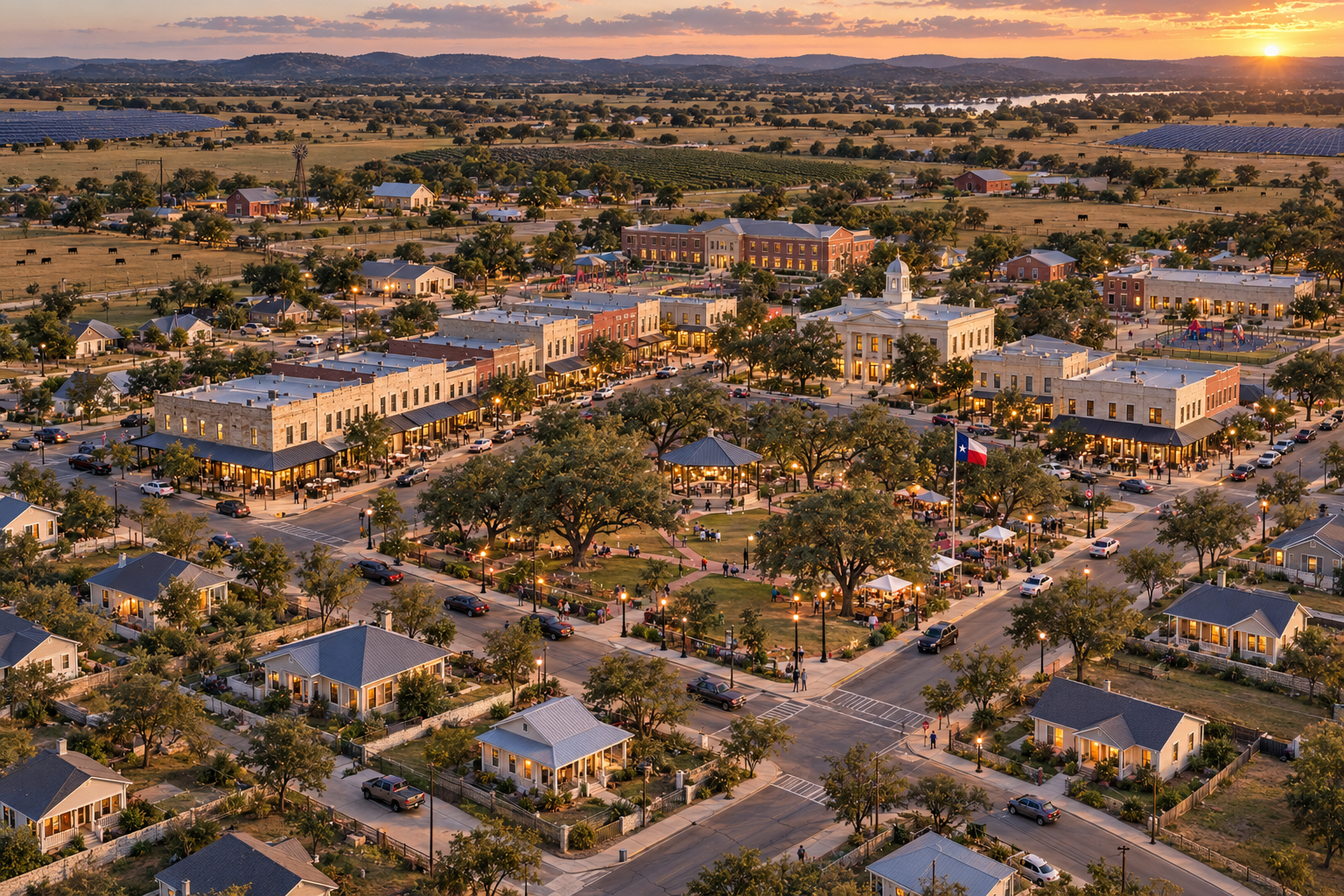
Energy plans should document capacity, delivery timing, reliability, and cost responsibility. Efficient homes, solar, storage, and demand management may contribute where engineering and economics support them. Solar fields in the illustration express a possibility; energy self-sufficiency requires analysis of demand, generation, storage, and grid arrangements.
Water plans must establish supply, competing demands, treatment capacity, drought response, and stewardship before growth commitments. Digital plans should distinguish secure facility networks from affordable broadband for homes and businesses. Each service needs identified providers, operating responsibilities, and long-term funding.
Record each proposed community commitment with its funder, owner, delivery milestone, maintenance budget, and remedy for nonperformance. Establish resident participation and public reporting. Address what happens if an operator delays, reduces, sells, or closes a project, with agreements developed through the appropriate public and legal processes.
Evaluate housing through the Total Monthly Cost of Living™: housing payments, utilities, transport, insurance, and maintenance. Support wellness through accessible care, comfortable walking routes, food options, recreation, and social connection. Track actual household experience as the town grows.
Build the square and the lasting economy
The square should be a useful public place before it becomes a marketing image. Picture a shaded green and modest pavilion, with a coffee shop, café, local market, community bank, small city hall, health clinic, and library around it. Homes and offices above storefronts add everyday activity. Phase these uses against real demand; some services may begin in shared space.
Nearby streets offer small porch cottages, attainable family homes, small luxe residences, accessible homes, and useful gardens. Lanterns and softly lit windows welcome evening activity. Safe crossings, comfortable sidewalks, practical parking, and service access support everyday life. Shade should be concentrated where people need it, with landscape choices appropriate to water availability and climate.
Working farms, ranches, and appropriately sited energy facilities connect the town to a wider landscape. Shared regional services can support smaller places. Each town should express its own setting and history, with growth shaped by residents rather than an identical development template.
Begin with the community already there. Restore useful buildings, assist home repairs, support established merchants, and protect opportunities for existing residents to remain. New investment should help people build local ownership and participate in the improvements.
A disciplined path through the next decade
First, listen to residents and establish a baseline: household demand and costs, public service capacity, environmental conditions, infrastructure, local businesses, and land stewardship. Identify the community’s priorities and the commitments needed to support them.
Then, deliver a focused first phase: rehabilitation, useful public space, essential infrastructure, appropriate workforce accommodation, and permanent housing supported by demand. Release later phases only when service capacity, occupancy, and funding support them. Avoid obligations dependent on peak construction activity.
As operations mature, grow independent businesses, remote-work capacity, education pathways, and regional partnerships. Test whether the community can remain viable if a single operator reduces activity. Neighboring towns can share specialized services while keeping their own character.
Publish a short scorecard covering household costs, housing choice, resident retention, local business ownership, educational opportunity, utility reliability, and public safety capacity. Identify responsible parties and corrective actions. Review whether the community can maintain its assets under a slower-growth scenario.
The next Texas Miracle could be a network of towns small enough to foster belonging and strong enough to sustain opportunity. The evidence will be what remains after construction: a thriving square, residents who can afford to stay, and an economy that offers the next generation more than one path forward.
Explore the map and supporting evidence
Begin with the GO interactive map to explore relationships among mapped data centers, Texas communities, and Texas A&M System sites. RELLIS is the initial reference point, not the limit of the report’s statewide vision. Select a mapped data center to move the 10-, 20-, 30-, and 40-mile rings; turn on the optional list to explore nearby communities.
Rings represent straight-line distances. They do not establish noise contours, safe distances, commute times, utility availability, or development feasibility. Facility status and coverage require project-level verification.
Read Data Centers and Communities and use the weighted checklist
Sources
1 Hershey Community Archives — Hershey Improvement Company Build or Buy a Home in Hershey
2 Hershey Community Archives — Accounts of the 1937 sit down strike
3 National Park Service — The Strike of 1894
4 Texas State Library and Archives Commission — Texas and Pacific Coal Company Thurber
5 Virginia JLARC — Data Centers in Virginia December 2024
6 Texas A&M AgriLife Extension — Community and Economic Development
7 Texas A&M AgriLife Extension — Disaster Preparedness and Recovery
This report presents GO’s vision and planning recommendations. The cover image is a conceptual illustration. Proposed programs, partnerships, housing choices, and funding arrangements are not commitments or endorsements by named institutions or mapped operators.